
Author1
This memo provides guidance for machine recounts and hand-to-eye recounts conducted by the county boards of elections. The section on the conduct of a hand-to-eye recount includes specific examples of how to determine questions of voter intent and covers both sample hand-to-eye recounts and full hand-to-eye recounts.
I. Machine Recounts
For contests within the jurisdiction of the county board of elections, a candidate can demand a machine recount if they are eligible to do so under N.C.G.S. § 163-182.7(b). The demand for a recount must be made in writing and must be received by the county board by 5:00 P.M. on the first business day after the county canvass.
For contests within the jurisdiction of the State Board of Elections, a candidate can demand a machine recount if they are eligible to do so under N.C.G.S. § 163-182.7(c). The demand for a recount must be in writing and must be received by the State Board by noon on the second business day after the county canvass.
1. Preparation for First Recount
1.1 Establish a schedule
Recounts must be scheduled to begin no later than three business days after the demand for a mandatory recount is received by the appropriate board of elections. However, if the demand for a recount is received before the county canvass, the earliest the recount can begin is the conclusion of the county canvass meeting.2
For recounts of contests within the State Board’s jurisdiction, the State Board will notify the county boards within the jurisdiction of the contest that a demand for a recount has been received. The county boards shall then proceed as follows:
- If the demand is received before or on the date set for the county canvass and the county canvass results confirm the candidate is eligible to demand a mandatory recount, then the county board will schedule the recount to begin as early as the first business day after the completion of the county canvass and within three business days of the State Board’s receipt of the demand for the recount, taking into account the notice requirements in Section I.1.2 of this memo.
- If the demand is timely received from an eligible candidate after the date set for the county canvass, then the county board shall schedule the recount to begin no later than three business days from being notified by the State Board that a recount has been demanded.
The county may combine multiple recounts of contests—both those within the county board’s jurisdiction and the State Board’s jurisdiction—into one recount when establishing the schedule, as discussed in Section I.4. of this memo.
The machine recount should be completed no later than the fifth business day after the recount begins. The county board shall endeavor to set a schedule where the recount can be completed by the day before the date of the State Board canvass meeting for the election.
If a county board is not using a high-speed scanner, the board should plan that it may be able to scan approximately 600 ballots per hour. If a county board is using a State Board or another county board’s high-speed scanner, the board meeting and scanning must occur in the county conducting the recount. Recounts may not take place in another county.
All counting teams should take a 15-minute break approximately every two hours of counting to avoid fatigue, which may lead to unintended errors. It is recommended that teams take at least a 30-minute meal break after counting periods in both the morning and afternoon. When approaching the anticipated break time, the counting team should determine when to take a break based on the estimated amount of time for a package of ballots to be completely scanned. The counting team should not take a break in the middle of scanning a package of ballots. When counting teams take a break, the ballots must be organized in a manner so that ballots are not counted twice when resuming the recount, and all ballots must be secured in a sealed container during the break. No ballots should be left unattended, even if in a sealed container.
When establishing a schedule, the county boards shall take into account other county board business that requires the presence of the county board members (e.g., hearings on protests). If a matter will require the presence of the county board members and timing considerations require the matter to be addressed while the recount is being conducted, then the county board should schedule that matter to be addressed at the end of the day so the recount itself remains as continuous as possible.
1.2 Notice the Recount
The county boards shall each notice a meeting to conduct a recount. The notice of the meeting shall be issued at least 48 hours before the recount begins. The notice of the recount shall be posted on the county board’s website and sent to the county’s notice list, county party chairs, and the candidates in the contest subject to the recount.3
The county boards shall provide the State Board and its Voting Systems Division with the locations and schedules of the recount by submitting a help desk ticket with that information.
The State Board will inform the state parties and post the recount schedules on the State Board’s website.
1.3 Secure a Location
Arrange for a location to conduct the recount. This may be the county board office or another location if more space is needed. The room should be arranged so that public observers are separated from the area where ballot tabulation is occurring. There should also be a designated area for board members to view the recount.
If a county board uses multiple rooms for a recount, they shall require that a permanent county staff member be assigned to each room and the staff member shall be designated as the recount captain for that room with at least a bipartisan team of two board members also present in each room. Assigning a recount captain helps maintain control over the recount and ensures that ballots and other items remain accounted for at all times.
1.4 Secure Bipartisan Teams
The county board shall arrange for two-person bipartisan teams for each tabulator, consisting of:
- Tabulator Attendant – will feed ballots into tabulator
- Tabulator Observer – will provide individual ballots to the tabulator attendant
The county board shall arrange for one person to manage the distribution of the voted ballots for each of the voting sites that are subject to the recount. Extra persons may be needed to assist or in case of emergencies.
Trained personnel, such as county board staff or appointed precinct officials, may be assigned by the county board to operate the tabulator in place of the bipartisan team described above, but only if they are overseen by a bipartisan team of supervisors. A bipartisan team of supervisors may assist the trained personnel as needed and may be assigned to oversee the operation of no more than four tabulators.
For the purpose of the recount, “bipartisan team” or “bipartisan team of supervisors” refers to a team of only members who are registered as affiliated with each of the two parties in the State with the largest number of registered voters.4
1.5 Organize Recount Materials
The location for the recount must have the necessary equipment and supplies to conduct the recount. This includes the voting equipment, blank USB sticks, blank ballots for any ballots that cannot be tabulated, additional paper rolls, extension cords and power strips, and a copy of this memo.
The county board shall also create a back-up copy of its official canvass data within its vendor’s tabulation software module (e.g. ERM/Results/Count).
2. Presence of Board Members
Recounts are open to the public and must be performed in the presence of a quorum of the county board or a bipartisan team of two board members.5 If a county board is using multiple locations for the recount, as discussed in Section I.1.3 of this memo, then at least a bipartisan team of two board members must be present in each location to oversee the recount.
The county board oversees the recount, with direct participation limited to only making determinations of voter intent when required. A quorum of board members, with at least one board member of each party represented on the board, must also be present to make determinations of voter intent when in question (e.g., damaged or “kicked out” ballots).6
3. Public Observance
Any person may attend the recount, including the candidates, their representatives or legal counsel, media representatives, and any other interested persons. These persons may observe the counting process but may not observe individual ballots. The bipartisan counting teams, members of the county board staff, and the county board members are the only persons who may view or handle the ballots. It is a best practice to have a sign-in sheet for persons in attendance observing the recount.
The county board shall exercise control over the conduct of the recount to ensure that the bipartisan counting teams do not experience interference from any person observing the recount. All persons who are not under the supervision of the county board are considered observers and shall not impede or disrupt the recount process in any way. If a county board has a practice of allowing public comment at its meetings, the county board shall inform those in attendance that there is no public comment period during the recount process. The county board shall issue a warning to any observer who engages in disruptive behavior that in the opinion of the county board threatens the orderly conduct of the recount. If the observer does not cease the offending conduct, the county board shall order the observer’s removal.7
It is recommended that observers wear badges or nametags identifying themselves and their role (candidate, media, etc.). The county board shall mark observer areas and require that observers remain within those areas unless otherwise permitted by the county board (e.g., in the case of an emergency, or if a candidate will view the results tape). If there is not sufficient room for all observers to view the recount, preference shall be given to candidates or a designee for a candidate. The county board must select a recount location that provides sufficient space for observation by at least the affected candidates or their designees.
The use of video or still cameras by the public inside the recount room is not permitted because of the statutory prohibition on photographing or videotaping individual ballots.8 The county board may enforce reasonable restrictions on items brought into the recount room such as telephones (e.g., requiring them to be put in silent mode and requiring that calls be made outside of the recount room) or food and drink (e.g., not permitting it within a certain distance of the recount materials). The county board may also enforce reasonable restrictions on noise or other disruptions in the counting location.9
4. Combining Recounts
It is permissible to combine recounts of multiple contests, if more than one recount has been properly requested, or if the board has decided to perform a discretionary recount in accordance with N.C.G.S. § 163-182.7(a). However, the combined recount must be properly noticed to the parties and candidates who may be affected by the recount.
5. Counting of Ballots and Voter Intent
Official ballots must be counted according to the principles and rules contained in N.C.G.S. § 163-182.1(a) during the initial count and for any recount10:
N.C.G.S. § 163-182.1. Principles and rules for counting official ballots.
(a) General Principles That Shall Apply. - The following general principles shall apply in the counting of official ballots, whether the initial count or any recount:
- Only official ballots shall be counted.
- No official ballot shall be rejected because of technical errors in marking it, unless it is impossible to clearly determine the voter's choice.
- If it is impossible to clearly determine a voter's choice in a ballot item, the official ballot shall not be counted for that ballot item, but shall be counted in all other ballot items in which the voter's choice can be clearly determined.
- If an official ballot is marked in a ballot item with more choices than there are offices to be filled or propositions that may prevail, the official ballot shall not be counted for that ballot item, but shall be counted in all other ballot items in which there is no overvote and the voter's choice can be clearly determined.
- If an official ballot is rejected by a scanner or other counting machine, but human counters can clearly determine the voter's choice, the official ballot shall be counted by hand and eye.
- Write-in votes shall not be counted in party primaries or in referenda, but shall be counted in general elections if all of the following are true:
- The write-in vote is written by the voter or by a person authorized to assist the voter pursuant to G.S. 163-166.8.
- The write-in vote is not cast for a candidate who has failed to qualify under G.S. 163-123 as a write-in candidate.
- The voter's choice can be clearly determined.
. . . .
For examples on how to apply the standards in N.C.G.S. § 163-182.1(a) to real-world scenarios, please see Numbered Memo 2019-07.
6. Recount Procedures
6.1 Opening Procedures
- Keep a log of attendees.
- Close the room when it reaches capacity as designated by the fire marshal. If possible, provide a video feed or a viewing area if attendance exceeds capacity, while making sure the camera is not positioned such that a viewer could view the voted ballots. As noted above, the recount room must provide sufficient space for observation by at least the affected candidates or their designees, and candidates or their designees shall be offered preference for seating in the recount room.
- Give attendees a name badge.
- Have signage to instruct those in attendance and communicate processes.
- Review recount procedures with those in attendance.
6.2 Preliminary Procedures
- The bipartisan team of officials and any assigned trained personnel shall take an oath.11
- The county board shall announce the name of each precinct, in-person early voting site, or absentee group to be tallied before beginning the recount process for that unit.
- The county board shall make a record of the number of the tamper-evident seal, protective counter, or other device, if any, before opening any of the voting equipment. The bipartisan team shall examine the electronic voting equipment to determine that any other tamper evident seals are intact and match the log maintained by the county board. The team shall note on the Recount Audit Sheet any irregularities or evidence of possible tampering with the device.
- The bipartisan teams, with the assistance of any assigned trained personnel, together shall complete an audit sheet to record the following:
- Machine serial number
- Precinct/unit name or code
- Voter history count
- Bipartisan team and assigned trained personnel name
- Date and time of beginning and end of recount
- The team or assigned trained personnel shall open the ballot box and inspect all compartments to ensure the bin is empty.
- A member of the bipartisan team or assigned trained personnel shall open the polls on the voting equipment and print a zero tape/report (“zero report”).
- Once the zero report prints, the bipartisan team shall inspect the report and confirm that it shows no results in the tabulator. The bipartisan team shall sign the zero report. If a candidate or their designee is in attendance, they along with any member of the public in attendance shall be offered the opportunity to view the zero report.
- A member of the bipartisan team or assigned trained personnel shall open the sealed ballot container for the voting site. This shall be done in full view of elections officials and observers.
- A member of the bipartisan team or assigned trained personnel shall remove ballots from the sealed ballot container and place ballots on the table.
- A member of the bipartisan team or assigned trained personnel may use an air spray can or give the ballots a gentle shake to remove any residue from the ballots.
- The tabulator observer shall take the stack of ballots that have been placed on the table and hand a ballot to the tabulator attendant one at a time (unless using a high-speed tabulator, in which case ballots can be processed in stacks by grouping).
If more than one ballot container is used per tabulator, then the ballots must be returned to their container after being scanned and the container resealed before a new container is unsealed.
6.3 Counting Procedures12
- The tabulator attendant shall feed the ballots into the tabulator.
- If after trying to insert the ballot by other orientations (i.e., front top, front bottom, back top, back bottom) a ballot cannot be tabulated, the ballot should be fed into the emergency bin on the tabulator (high-speed tabulators will automatically separate such ballots). Before the ballot is placed into the emergency bin, the ballot attendant shall announce: “Damaged Ballot.” An overvoted ballot is not a damaged ballot. Ballots with overvotes can be tabulated by machine and should be accepted by the tabulator after it provides a warning message.
- If any individual ballot is marked as a provisional ballot and is found in the tabulator for a precinct or early voting site, and that ballot is for a provisional application that was not approved by the county board for counting at its provisional meeting, the ballot shall not be fed into the tabulator, but instead shall be placed into the emergency bin. Before the ballot is placed into the emergency bin, the ballot attendant shall announce: “Provisional Ballot.”
- The bipartisan team or assigned trained personnel will continue to tabulate ballots removed from the ballot container and have them fed into the tabulator throughout the counting process.
- The counting process will be conducted in two-hour intervals. After one hour, the team members shall reverse roles.
- At the end of each counting period, the ballot box will be opened by the tabulator attendant and the ballots will be bundled and sealed. The number of ballots sealed in the ballot container shall be recorded.
- At the start of each counting period, at the one-hour role switch, and at the end of each counting period, a bipartisan team member shall record the number of ballots on the public count of each machine, along with the number of ballots placed in the emergency bin, and the number of ballots that have been removed from the ballot container.
- Once all ballots have been removed from the ballot container, the tabulator attendant shall open the emergency bin and remove any damaged ballots or provisional ballots that were required to be entered into the bin. Each ballot type shall be handled as follows:
- Damaged ballots: Examine “kicked out” ballots to determine the reason and show to board members for their determination as to voter intent, in accordance with the Section I.5 of this memo “Counting of Ballots and Voter Intent.” All ballots that were rejected for tabulation purposes by the machine shall be recounted by hand by a bipartisan team of four, who shall be designated and shall proceed as provided in Section II.1.4 of this memo. Where possible, the bipartisan team of four should be overseen by the bipartisan team or bipartisan team of supervisors originally assigned to the tabulator.
- Provisional ballots found in the tabulator for a precinct or early voting site, and that ballot is for a provisional application that was not approved by the county board for counting at its provisional meeting: place ballot in envelope marked “retrieved provisional” and then keep the envelope with that precinct/early voting site ballots.
- Finally, the bipartisan team shall review a report showing the number of reported ballots cast per precinct or site and verify that this is the total number of ballots tabulated for that site in the recount.
6.4 Tabulation
- Close the polls: Once the bipartisan teams and any assigned trained personnel have completed their work, a member of the county board or a county board staff member shall place the tabulator into postelection mode and generate a results tape/report (“results report”) for the reporting unit.
- Once the report prints, the bipartisan team members shall sign the results report. If a candidate or their designee is in attendance, they along with any member of the public in attendance shall be offered the opportunity to view the results tape/report or its equivalent, but only for the contest or contests subject to the recount. All other contests not subject to a recount must be masked from view.
- In the presence of at least two members of the county board, a county board staff member shall compare the contest results on the results report to the canvassed results in the results tabulation software for any contest that is being recounted.
- If the results of any contest being recounted have changed from the Canvass results for that contest, county board staff shall edit the results of the recounted contest manually within the Election Management System (EMS) to accommodate such changes, for all precincts/reporting groups in which such edits are necessary.
- The county board shall print a block style canvass report and create a results file (ASCII, CSV, etc.) for import into SEIMS Election Reporting.
- The county board shall import the results file from the vendor’s tabulation software module (ASCII, CSV etc.) into Election Reporting under the “Canvass Recount’ menu. Contests that are eligible for a recount will be enabled.
- The county board must compare the results on the results tabulation software report to the totals in Election Reporting.
6.5 Wrap Up
- Replace all the voted ballots in the security containers in which they were stored and reseal the container.
- The container shall be labeled with the precinct name and the bipartisan team members shall sign the seal.
- Board members shall sign a seal that has been placed on the ballot boxes/containers after results are obtained.
7. Possible Sample Hand-to-Eye Count
A sample hand-to-eye recount may be necessary if one of the candidates demands one. The demand for a sample hand-to-eye recount can be made orally or in writing. If the candidate makes the demand orally, then the board receiving the demand shall request that they put the demand in writing so it can be documented. The board receiving the demand shall date and time stamp the written demand.
Any demand for a sample hand-to-eye recount must be made within 24 hours of the conclusion of the first recount.13 If the contest is a multicounty or statewide contest, then this is measured from the conclusion of the recount across all counties in the jurisdiction. The recount shall be considered to have concluded when the results have been uploaded into SEIMS Election Reporting. The county board staff should also submit a Help Desk ticket that the county board has finished once the results have been uploaded.
For contests within the county board’s jurisdiction, the county board shall, within 1 hour of the conclusion of the recount, provide written notice of the date and time that the recount concluded by email or hand-delivery to the candidates in the contest. For contests within the State Board’s jurisdiction, the State Board will, within 1 hour of the conclusion of the recount, provide written notice of the date and time that the recount concluded by email to the candidates in the contest.
If a sample hand-to-eye recount is timely-demanded, it shall be conducted in accordance with Section II of this memo.
II. Hand-to-Eye Recounts
There are two kinds of hand-to-eye recounts: a sample recount and a full recount. A sample recount involves a hand-to-eye recount of all ballots cast in 3% of in-person voting sites in each county in the jurisdiction of the contest, in accordance with state law. In the event of a sample hand-to-eye recount, only contests where such a recount has been validly requested under N.C.G.S. § 163-182.7A shall be recounted. If more than one such recount has been validly requested and applies to a county, those sample hand-to-eye recounts may be combined.
If the county board is conducting a recount of a contest within the State Board’s jurisdiction, the sample for each county shall be drawn at random by the State Board staff in a publicly noticed drawing, and selections will be distributed to the county boards of elections by email and posted to the State Board’s website.
If a county board has combined sample hand-to-eye recounts of a contest within the county board’s jurisdiction and a contest within the State Board’s jurisdiction, and the jurisdiction of the contest within the county is the same (e.g., one contest is a congressional contest where the entire county is part of the district, and the local contest is a countywide county commission contest), then the precincts chosen by the State Board shall be used for the combined recount. However, if the jurisdiction of the contests do not completely coincide, the sample for the contest within the county board’s jurisdiction shall be drawn by the county board at random in a publicly noticed drawing, with notice being provided in accordance with Section II.1.2 of this memo.
The sample shall be all the ballots in three percent (3%) of the precincts casting ballots in each county in the jurisdiction of the office, rounded up to the next whole number of precincts. The sample chosen shall be of one or more full precincts or full counts of one or more in-person early voting sites, or a combination.14 Unlike the statute governing sample audits after Election Day, the sample hand-eye recount statute does not include absentee ballots in the sampling. For selecting the precincts or early voting sites for a contest within the jurisdiction of the State Board, the State Board will use the same randomization procedure that it used for the sample audit after Election Day.
In the event the results of the sample hand-to-eye recount differ from the machine recount results within those voting sites such that extrapolating the amount of the change to the entire district (based on the proportion of ballots recounted to the total votes cast for that office) would result in reversing the results, the State Board will order a full hand-to-eye recount in that contest.
1. Preparation for Recount
1.1 Establish a Schedule
Recounts must begin within two business days of the demand for a hand-to-eye recount being received by the board of elections with jurisdiction over the contest.15 For hand-to-eye recounts of contests within the State Board’s jurisdiction, the State Board will notify the county boards within the jurisdiction of the contest that a demand for a sample hand-to-eye recount has been received.
The random sample for the recount must be chosen within one business day of the timely receipt of a demand for a hand-to-eye recount, and the recount may begin as soon as the random sample has been chosen if the county has given notice of the recount. Otherwise, the recount must begin by the second business day after the timely demand. The sample hand-to-eye recount should be completed by the end of the day on the fifth business day after the start of the recount.
All counting teams should take a 15-minute break approximately every two hours of counting to avoid fatigue, which may lead to unintended errors. It is recommended that teams take at least a 30-minute meal break after counting periods in both the morning and afternoon. When approaching the anticipated break time, the counting team should determine when to take a break based on the estimated amount of time for a package of ballots to be completely recounted. The counting team should not take a break in the middle of recounting a package of ballots. When counting teams take a break, the ballots must be organized in a manner so that ballots are not counted twice when resuming the recount, and all ballots must be secured in a sealed container during the break. No ballots should be left unattended, even if in a sealed container.
When establishing a schedule, the county boards shall take into account other county board business that requires the presence of the county board members (e.g., hearings on protests). If a matter will require the presence of the county board members and timing considerations require the matter to be addressed while the recount is being conducted, then the county board should schedule that matter to be addressed at the end of the day so the recount itself remains as continuous as possible.
1.2 Notice the Recount
Prepare and publish notice of the recount at least 24 hours before the recount will begin by email to the county’s notice list, county party chairs, the candidates in the contest, any attorneys for the candidates in the contest, and other interested parties.16 The county board should also post it on its website, if possible. If the county board issued a proactive notice for a recount, that satisfies the notice requirement so long as the notice was sent to the persons and parties identified above at least 24 hours before the recount will begin in the county.
The county boards shall provide the State Board and its Voting Systems Division with the locations and schedules of the recount by submitting a help desk ticket with that information. The State Board will inform the state parties and post the recount schedules on the State Board’s website.
1.3 Secure a Location
Arrange for a space to conduct the recount. This may be the county board office or another location in the county if the county board office is not sufficiently large. The room should be arranged so that public observers are separated from the area where the hand tallying is occurring. There should also be a designated area for board members to view the recount.
The director or their designee shall be assigned the role of recount captain. Assigning a recount captain helps maintain control over the recount and ensures that ballots and other items are accounted for at all times. The recount captain shall have in their possession a report of the results of the contest from the election management software.
If a county board uses multiple rooms for a recount, they shall require that a permanent county staff member be assigned to each room and the staff member shall be designated as the recount captain for that room with at least a bipartisan team of two board members also present in each room. The county board of elections shall arrange for one person to manage the distribution of the voted ballots for each of the voting sites that are subject to the recount. The county board may need extra persons to assist or in case of unexpected staffing problems.
The county board must select a recount location that provides sufficient space for observation by at least the affected candidates or a designee for a candidate. If there is not sufficient room for all observers to view the recount, preference shall be given to candidates or their designees.
Public attendees must be able to see and hear the proceedings without compromising the secrecy of any voter’s ballot or other confidential information. If broadcast by video feed, staff must ensure that the public cannot view any voted ballots or other confidential information, such as voter signature, on the video feed. A staff member should be assigned to monitor the video feed throughout the recount to ensure that confidential information is not viewable by the public. County board members and staff must be particularly mindful of ballot secrecy throughout the recount proceedings.
1.4 Secure Bipartisan Teams
The county board of elections shall arrange for a bipartisan team of four North Carolina registered voters to conduct the recount as follows:
- A team of two officials who are registered as affiliated with each of the two parties in the State with the largest number of registered voters (i.e., one Democrat and one Republican) to relay the results of each ballot. One person will read the ballot and the other official will ensure the correct vote was read aloud.
- A team of two officials who are registered as affiliated with each of the two parties in the State with the largest number of registered voters (i.e., one Democrat and one Republican) to record the tally of votes for each candidate on paper. Each of the two officials shall separately record the tally. For every vote for a candidate, each official shall place a vertical line on the tally sheet. After every fifth vote for each candidate, each official shall place a diagonal line across the four vertical lines and state aloud the word “tally.” If the two officials do not both state the word “tally”, the team shall resolve the difference before proceeding.
Bipartisan team members must be registered voters in the State. If a county board has diligently sought to fill the positions with voters affiliated with the Democratic and Republican parties, but still has an insufficient number of officials for the recount, the county board by a bipartisan majority vote of its members may appoint to the bipartisan team an unaffiliated voter or voter affiliated with one of the other political parties recognized in North Carolina.17 In no instance shall the county board appoint more than two members to a bipartisan team who are unaffiliated or affiliated with one of the other political parties. Members of the bipartisan team should wear badges or nametags identifying themselves and their role.
1.5 Organize Recount Materials
The county board should place “Quiet Please – Counting in Progress” or other similarly worded signage in the recount location. Tables used for the recount should be clear of all items except for the ballots to be counted, pencils, tally sheets, and any reconciliation or chain of custody documents. Teams should not be permitted to have food or drink near the ballots. The room(s) used for the recount should be cleared of all other ballots, ballot boxes, and other storage items.
The county board shall also ensure that seals and other security materials to secure the ballots following the recount are readily available.
2. Presence of Board Members
Recounts are open to the public and must be performed in the presence of a quorum of the board (any three members) or a bipartisan team of two board members.18 If utilizing a bipartisan team of two members, that bipartisan team shall be chosen by the county board.
County board members shall not serve on the bipartisan counting teams for hand-to-eye recounts.19 Their role is to supervise the recount proceedings and determine questions of voter intent. See Section II.4 of this memo, Counting of Ballots and Voter Intent.
3. Public Observance
Any person may attend the recount. This includes the candidates, their representatives or legal counsel, media representatives, and any other interested persons. These persons may observe the counting process but may not observe individual ballots. The bipartisan counting teams, members of the county board staff, and the county board members are the only persons who may handle the ballots and other election materials. It is a best practice to have a sign-in sheet for persons in attendance observing the recount.
The county board of elections shall exercise control over the conduct of the recount to ensure that the bipartisan counting teams do not experience interference from any person observing the recount. All persons who are not under the supervision of the county board of elections are considered observers and shall not impede or disrupt the recount process in any way. If a county board has a practice of allowing public comment at its meetings, the county board shall inform those in attendance that there is no public comment period during the recount process. The county board shall issue a warning to any observer who engages in disruptive behavior that in the opinion of the board of elections threatens the orderly conduct of the recount. If the observer does not cease the offending conduct, the county board shall order the observer’s removal.20
It is recommended that observers wear badges or nametags identifying themselves and their role (candidate, media, etc.). The county board of elections shall mark observer areas and require that observers remain within those areas unless otherwise permitted by the board of elections (e.g., in the case of an emergency). The county board should place signage designating the area and communicating instructions of the proceedings and permissible conduct. If there is not sufficient room for all observers to view the election materials, preference shall be given to candidates or their designees.
The use of video or still cameras by the public inside the recount room is not permitted because of the statutory prohibition on photographing or videotaping individual ballots.21 Members of the media are permitted to take photos or videos before or after the recount occurs, or in a manner that ensures no voted ballot can be recorded. The county board may enforce reasonable restrictions on items brought into the recount room such as telephones (e.g., requiring them to be put in silent mode and requiring that calls be made outside of the recount room) or food and drink (e.g., not permitting it within a certain distance of the recount materials). The county board may also enforce reasonable restrictions on noise or other disruptions in the counting location.22
4. Counting of Ballots and Voter Intent
4.1 Board Must Determine Voter Intent
Voter intent is the governing standard when questions arise about how to adjudicate markings on a ballot. Questions about voter intent can arise during a hand-to-eye recount if a voter marks the ballot in an inappropriate manner, places marks in the wrong location on the ballot, or otherwise marks the ballot in a manner that causes the voter’s choice to be in dispute. This memo supplements Numbered Memo 2019-07, which is still in effect.23
Determinations of voter intent must be made by the county board. If the bipartisan counting team encounters a ballot that cannot be clearly identified as a vote for one candidate or another, the ballot must be set aside. All ballots with a potential overvote or undervote, including ballots that appear to be left completely blank for the contest, shall be adjudicated by the county board at the conclusion of the tallying for the precinct/early voting site by the bipartisan team. If the contest was clearly left blank—meaning there are no marks in the target or candidate area for the contest, or any other mark or comment indicating support for a candidate for the office—the county board shall treat that as an undervote and the ballot shall not be counted for any candidate. Undervotes and overvotes must be accounted for in the county board’s tally sheets, even though they do not count for any candidate in the contest, to ensure that the number of ballots counted is properly reconciled with the number of ballots cast and the number of ballots counted in the machine recount.
4.2 Statutory Requirements
Official ballots shall be counted according to the principles and rules contained in N.C.G.S. § 163-182.1(a):
“(1) Only official ballots shall be counted.
(2) No official ballot shall be rejected because of technical errors in marking it, unless it is impossible to clearly determine the voter's choice.
(3) If it is impossible to clearly determine a voter's choice in a ballot item, the official ballot shall not be counted for that ballot item, but shall be counted in all other ballot items in which the voter's choice can be clearly determined.
(4) If an official ballot is marked in a ballot item with more choices than there are offices to be filled or propositions that may prevail, the official ballot shall not be counted for that ballot item, but shall be counted in all other ballot items in which there is no overvote and the voter's choice can be clearly determined.
(5) If an official ballot is rejected by a scanner or other counting machine, but human counters can clearly determine the voter's choice, the official ballot shall be counted by hand and eye.
(6) Write-in votes shall not be counted in party primaries or in referenda, but shall be counted in general elections if all of the following are true:
a. The write-in vote is written by the voter or by a person authorized to assist the voter pursuant to G.S. 163-166.8.
b. The write-in vote is not cast for a candidate who has failed to qualify under G.S. 163-123 as a write-in candidate.
c. The voter's choice can be clearly determined.”
4.3 Uploading Results
The county board shall reconcile the number of ballots counted at each voting site selected for the hand-to-eye recount with the number of ballots counted at those sites during the machine recount.
The results of the sample hand-to-eye recount are not to be uploaded into the county board’s election management system or election night reporting. This is because N.C.G.S. § 163-182.2(a)(6) generally provides that, in its canvass, a board of elections shall rely on the mechanical or electronic count of the vote, rather than the sample hand-to-eye audit or sample hand-to-eye recount. County boards shall instead report the results of their sample recount in a survey that will be provided to collect this information. This survey will compare the results of the machine recount for the sample group against the hand-to-eye recount results for that same group of ballots.
Only in the event of a full hand-to-eye recount, if there is a material discrepancy between the electronic or mechanical count and the full hand-to-eye count or recount will the hand-to-eye count control, except where paper ballots or records have been lost or destroyed or where there is another reasonable basis to conclude that the hand-to-eye count is not the true count.24
The county board or State Board with jurisdiction over the contest will compare the full hand-to-eye recount results to the machine recount results to determine whether any differences are material.25 County boards shall retain all media devices in a secure location in the event the State Board directs that the results are to be uploaded into the election management system.
4.4 Retaining Adjudicated Ballots
County boards must separately retain and store all ballots where voter intent was adjudicated by the board. This includes those ballots determined to be an undervote because they were completely blank for the contest. Any such ballots shall be placed in a labeled envelope or container and clearly marked as ballots for which voter intent was adjudicated, to ensure that the ballots can later be retrieved in the event of a dispute.
5. Guidelines for Determining Voter Intent
For any printed ballot that is to be counted hand-to-eye, the following guidelines shall be used in determining voter intent. Each of the below sections contains examples of the guidelines for determining voter intent listed in 08 NCAC 09 .0109(c). For purposes of this guidance, in accordance with 08 NCAC 09 .0109(b), the following definitions apply:
- “Target area” is the square or oval next to the candidate’s name on the printed ballot.
- “Candidate area” is the area between the lines separating candidate names, or the area that is clearly closer to one candidate’s name than another. “Candidate area” includes the candidate’s name and party affiliation, if listed.
5.1 Guidelines For Votes That Should Be Counted
5.1.1 Any ballot that is properly marked in the target area for one candidate only shall be designated as a vote for that candidate.
Examples of votes that shall be counted:
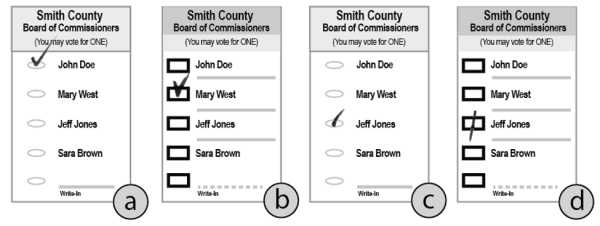
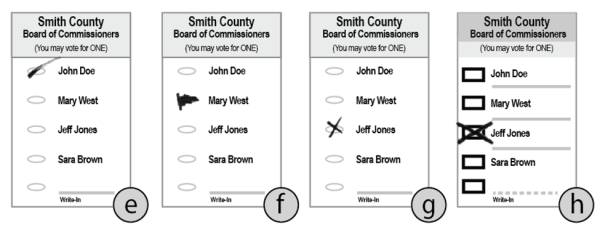
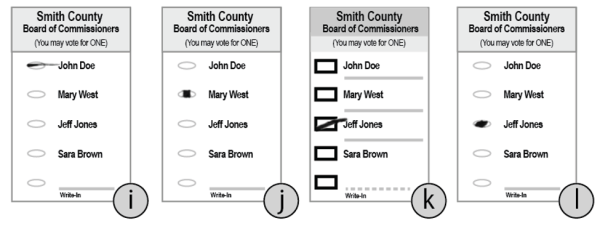
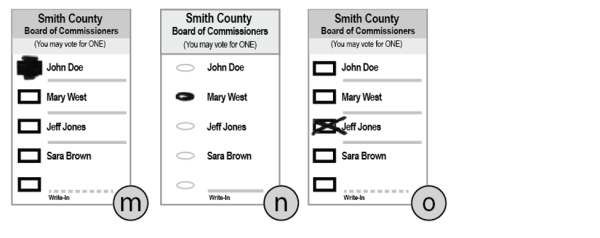
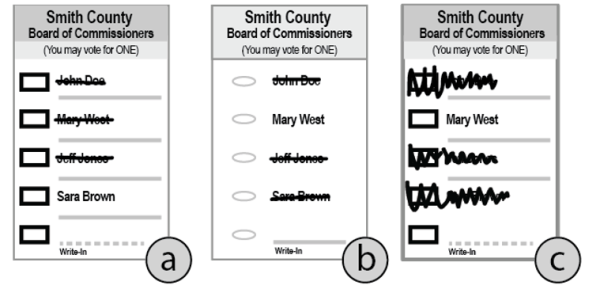
5.1.2 If the names of all but one candidate are stricken through, the ballot shall be counted for the one candidate whose name was not stricken through.
Examples of votes that shall be counted for the candidate whose name is NOT stricken through:
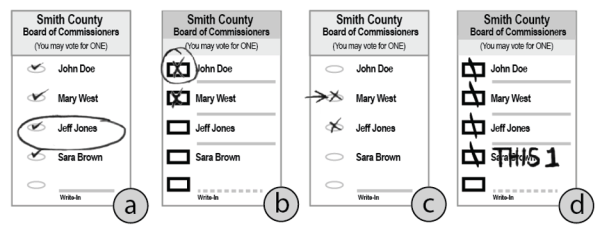
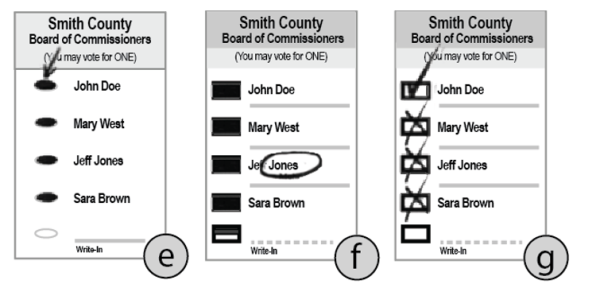
5.1.3 If there are identical marks for two or more candidates, clarified by an additional or different mark or marks that appear to indicate support for one candidate, the ballot shall be counted as a vote for the candidate with the additional or different marks
Examples of votes that shall be counted for the candidate with the additional clarifying mark:
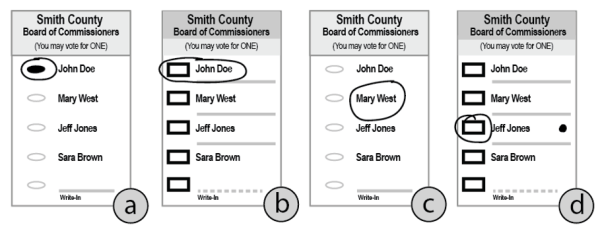
5.1.4 Any ballot that has any other mark or marks in the target area or candidate area for one candidate only, including circling the target area and/or the candidate’s name or making a mark through the target area or candidate’s name, provided no other candidate for that office is similarly marked, shall be counted as a vote for that candidate.
Examples of votes that shall be counted:
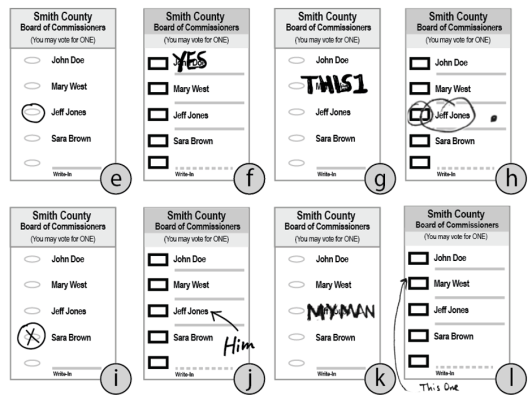
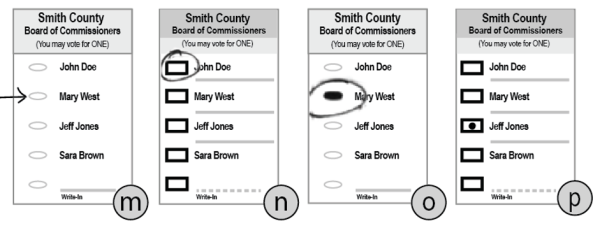
5.1.5 Any ballot that has a mark or marks in the target area or candidate area for one candidate, which extends partially into one or more other target areas or candidate areas, shall be counted as a vote for the candidate so marked only if a majority of the mark is in that candidate’s area or target area, it is readily apparent that the voter intended to vote for that candidate, and no other candidate is similarly marked.
Examples of votes that shall be counted:
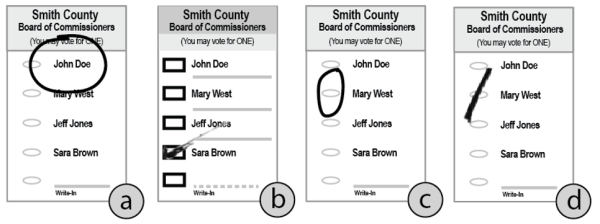
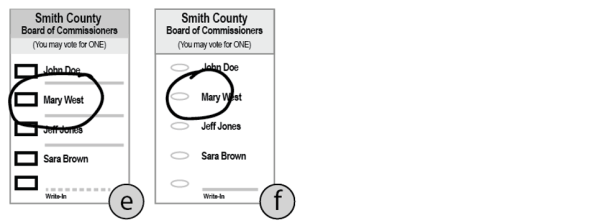
5.1.6 Marks extending across more than one candidate’s area may be counted if the lines of the “x” or the bottom point of the check mark clearly lie inside the box or on top of the name or party affiliation or candidate area of one candidate, and no other candidate is similarly marked.
Examples of votes that shall be counted:
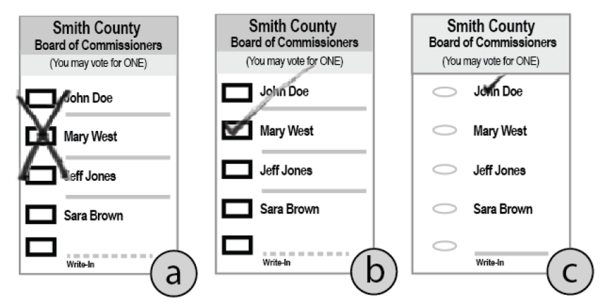
5.1.7 Any ballot that has a mark in the target area or candidate area for one candidate, and on which other marks in the target areas or candidate areas for any other candidates have been partially erased, scratched out, or otherwise obliterated, shall be counted as a vote for the candidate for which the mark was not erased, scratched out, or otherwise obliterated, provided no other candidate is similarly marked.
Examples of votes that shall be counted:
To be counted for John Doe:
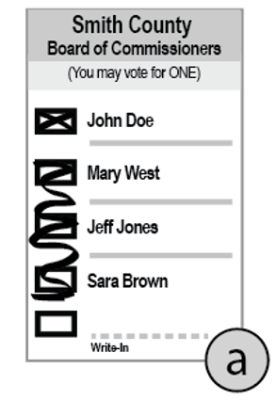
To be counted for Mary West:
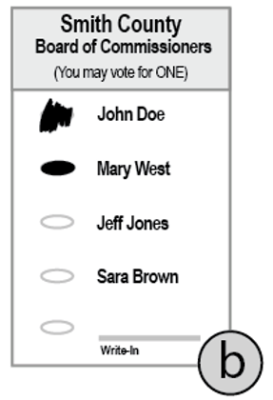
To be counted for Jeff Jones:
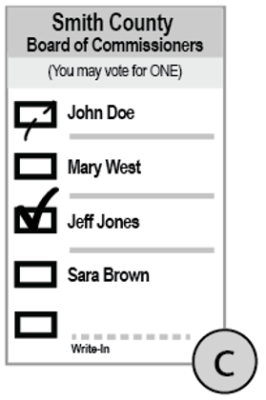
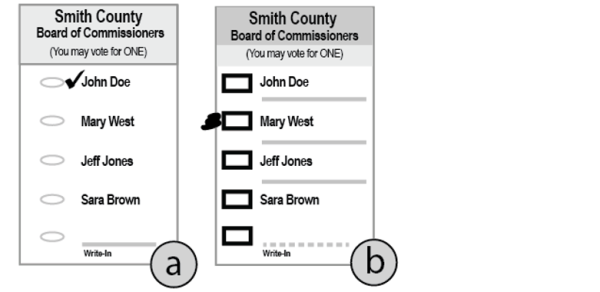
5.1.8 Any ballot that has a mark that is clearly next to (either before or after) a candidate's name, or across the name, shall be recognized as a mark for that candidate. Similarly, a mark between or over the "timing marks" of the ballot, that are clearly opposite or next to one candidate's name and not near another candidate's name, shall be recognized as a mark.
Examples of votes that shall be counted:
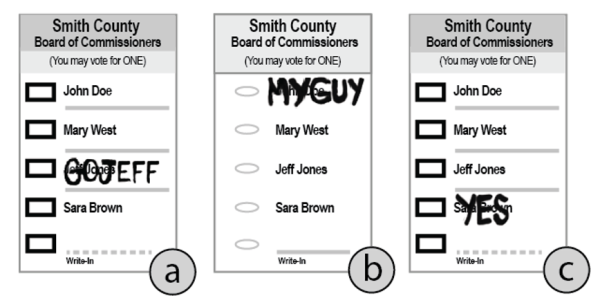
5.1.9 Any writing or comment on the ballot (other than a write-in) that clearly indicates the voter's support for one and only one candidate for the office, and that cannot be interpreted as a comment in favor of any other candidate in that election, shall be counted as a vote for that candidate.
Examples of votes that shall be counted:
5.2 Guidelines For Votes That Should Not Be Counted
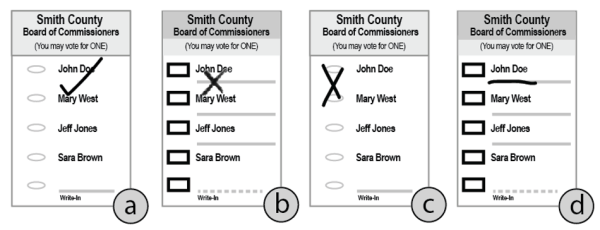
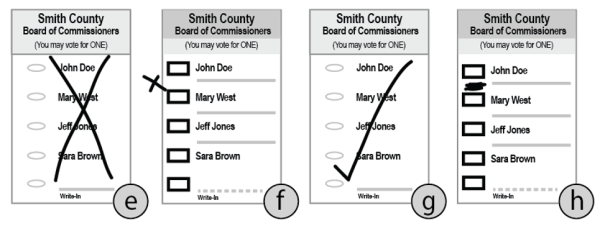
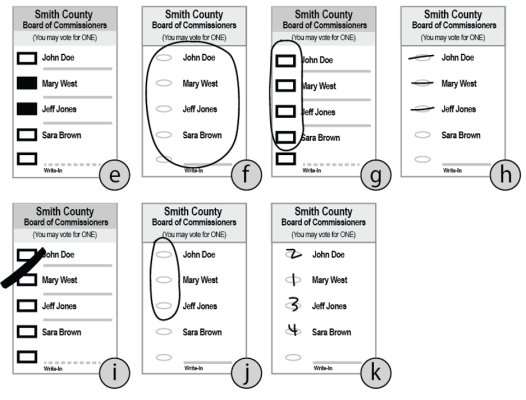
5.2.1 A mark that is between or across more than one candidate’s name, candidate area, or target area shall not be recognized as a vote.
Examples of votes that shall not be counted:
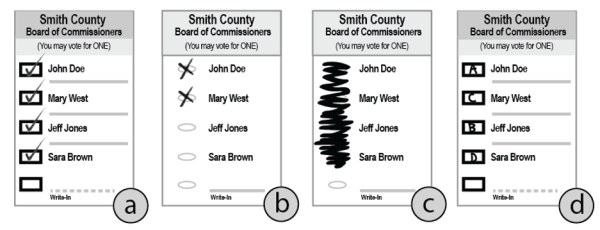
5.2.2 Any ballot that is marked for more than one candidate for the office shall be deemed an overvote and no vote shall be counted for that ballot item.
Examples of votes that shall not be counted:
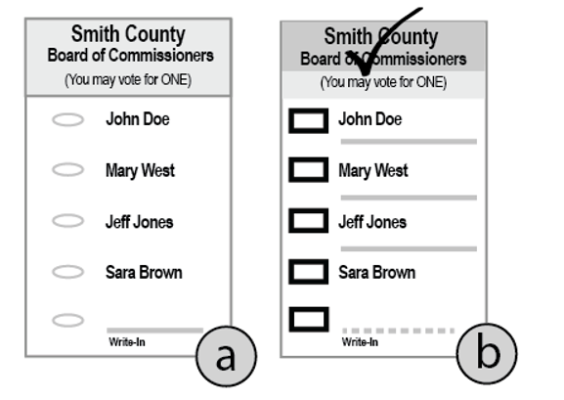
5.2.3 Any ballot on which there is no mark under the office, or any other mark or comment indicating support for a candidate for the office, is an undervote and shall not be counted as a vote for any candidate.
Examples of votes that shall not be counted:
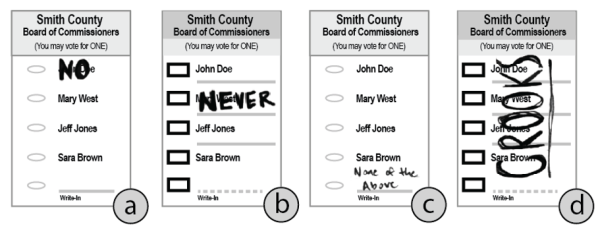
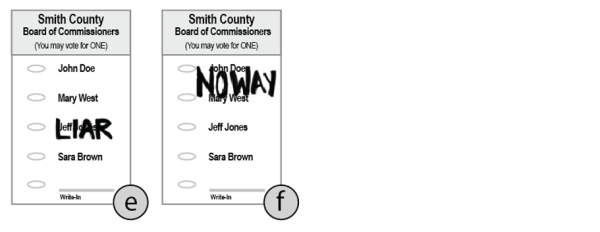
5.2.4 A mark that is clearly a negative or extraneous comment, or which indicates the voter’s opposition to one or more candidates, shall be considered an undervote, provided the ballot is not so marked to indicate which candidate the voter supports.
Examples of votes that shall not be counted:
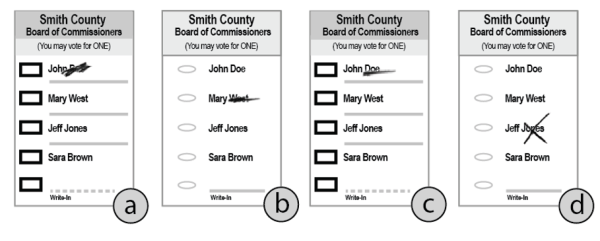
5.2.5 If a substantial part of the candidate’s name is crossed through or stricken out, the mark shall be considered an undervote and shall not be counted.
Examples of votes that shall not be counted:
III. Precinct Sort
County boards shall not conduct the precinct sort until all recounts, and any protests involving the recounts, have been completed. This could mean a county board may not be able to complete the precinct sort by 30 days after the election. Even if this is the case, N.C.G.S. § 132.5G(d) requires that “the chair of the county board of elections appear and explain the delay at the next official meeting of the State Board.” The county board chair may report that the delay was due to the recount by sending an email with that explanation to the State Board’s legal department so that the board chair does not need to appear in person at a State Board meeting.
IV. Discretionary Recounts
A county board of elections has the authority to order a discretionary recount “when necessary to complete the canvass in an election,” unless the State Board has already denied a recount to the candidate requesting that recount.26 A county board shall only order a discretionary recount when the board has made a finding with specific determinations as to why it is necessary to conduct the recount in order to complete the canvass. When doing so, that finding should be made in an open meeting, which could include the canvass meeting, and shall be reduced to writing in a resolution. Discretionary recounts ordered by a county board shall follow the procedures in this memo first for machine recounts and, if the board further finds it necessary to complete the canvass, hand-to-eye recounts.27 A discretionary first recount must begin within three business days of the decision to conduct a discretionary recount.28
- 1
[1] This memo is issued under the authority delegated by the State Board to the executive director pursuant to N.C.G.S. § 163-22(p) using the procedures in the State Board’s August 6, 2026, resolution. This memo replaces the guidance for recounts in specific elections provided in previous Numbered Memos.
- 2
08 NCAC 09 .0107.
- 3
08 NCAC 09 .0106(a). Note that the county can also notice the sample hand-to-eye recount in the same notice for the first recount. 08 NCAC 09 .0110 (“No separate notice of a hand-to-eye recount is required if the hand-to-eye recount occurs on the same day as and following the conclusion of the first recount under 08 NCAC 09 .0107 and the notice of the first recount stated that a hand-to-eye recount, if required, could take place upon the conclusion of the first recount.”).
- 4
Note that a bipartisan team of four voters affiliated with each of the two parties in the State with the largest number of registered voters may be required. See 08 NCAC 09 .0107 (“All ballots that are rejected for tabulation purposes by the machines during the recount shall be recounted by hand by a bi-partisan team of four in accordance with 08 NCAC 09 .0106(d).”); see also Section I.6.3 of this memo.
- 5
08 NCAC 09 .0106(h).
- 6
08 NCAC 09 .0106(h).
- 7
N.C.G.S. § 163-182.2(a)(3): “Any member of the public wishing to witness the vote count at any level shall be allowed to do so. No witness shall interfere with the orderly counting of the official ballots. Witnesses shall not participate in the official counting of official ballots.”
- 8
N.C.G.S. § 163-165.1(e). This does not preclude providing an area from which observers can take picture or video of the recount, so long as they do not capture the image of a voted ballot. Nor does it preclude the county board from livestreaming the recount so long as the video feed does not reveal a voted ballot.
- 9
N.C.G.S. § 163-33(1).
- 10
08 NCAC 09 .0106(c).
- 11
Suggested oath: “I, ____, do solemnly swear (or affirm) that I will support the Constitution of the United States; that I will be faithful and bear true allegiance to the State of North Carolina, and to the constitutional powers and authorities which are or may be established for the government thereof; that I will endeavor to support, maintain and defend the Constitution of said State not inconsistent with the Constitution of the United States; that I will honestly discharge the duties of recounting ballots in ___ County for the primary (or election) held this day, and that I will fairly and honestly tabulate the votes cast in said primary (or election); so help me, God.”
- 12
If any tasks in this section are performed by trained personnel in lieu of a bipartisan team, then a bipartisan team of supervisors must be able to view and observe the completion of that task.
- 13
N.C.G.S. § 163-182.7A; 08 NCAC 09 .0107.
- 14
See N.C.G.S. § 163-182.7A.
- 15
08 NCAC 09 .0110.
- 16
08 NCAC 09 .0110.
- 17
08 NCAC 09 .0106(d).
- 18
08 NCAC 09 .0106(h).
- 19
08 NCAC 09 .0106(d).
- 20
N.C.G.S. § 163-182.2(a)(3): “Any member of the public wishing to witness the vote count at any level shall be allowed to do so. No witness shall interfere with the orderly counting of the official ballots. Witnesses shall not participate in the official counting of official ballots.”
- 21
N.C.G.S. § 163-165.1(e). This does not preclude providing an area from which observers can take picture or video of the recount, so long as they do not capture the image of a voted ballot. Nor does it preclude the county board from livestreaming the recount so long as the video feed does not reveal a voted ballot.
- 22
N.C.G.S. § 163-33(1).
- 23
See also Numbered Memo 2020-32 and Numbered Memo 2024-09.
- 24
N.C.G.S. § 163-182.2(a)(6).
- 25
See N.C.G.S. § 163-182.4.
- 26
N.C.G.S. § 163-182.7(a).
- 27
If the discretionary recount proceeds to a full hand-to-eye recount, the county board “shall rely in its canvass on the mechanical or electronic count of the vote rather than the full hand-to-eye count of the paper ballots or records” unless there is “a material discrepancy between the electronic or mechanical count and a hand-to-eye count or recount, [in which case] the hand-to-eye count or recount shall control, except where paper ballots or records have been lost or destroyed or where there is another reasonable basis to conclude that the hand-to-eye count is not the true count.” N.C.G.S. § 163-182.2(a3) (recodified from 163-182.2(a)(6) in Session Law 2026-60 § 1.2).
- 28
08 NCAC 09 .0107.